
Copilot Studio agent consumption, who pays for the party?

If you attend talks or events related to Microsoft technologies, you may have seen that when someone asks a question about licensing, they most often do not get wet and try to dodge it. Wondering why? I'm going to try to make you visualize it with a metaphor from cinema: entering the world of licensing is like entering the labyrinth of the movie The Shining, you feel lost in a dark, cold place, from which you don't know how to get out and with a psychopath chasing you. But who said fear? Like the protagonist of a horror movie who decides to go down to the basement without turning on the light, here I come ready to try to explain to you how the party of the agents of Copilot Studio is paid.
And for this I am going to try to light the way with 5 questions.

And now, we explain each question one by one.
1. The engine that builds your agent: the harness
If you're a LinkedIn user, you might be seeing the word harness everywhere. So what is that? Well, to put it simply, the engine on which you are going to build your agent. And you're also likely to think , 'I've already made agents with Copilot Studio and I've never had to select the harness anywhere.' And you're not wrong, because all this comes from the new Copilot Studio experience, depending on the one you choose to build your agent, you'll be using one harness or another. We have three:
Standard harness: the classic experience, the one you have used so far (topics, variables, tools, etc).
Copilot Chat harness: To extend Microsoft 365 Copilot Chat with business knowledge.
GitHub Copilot harness: the new experience, designed for complex and multi-step reasoning tasks (skills, memory, etc.).
Here's the first key: if you choose GitHub Copilot's harness, your agent bills for credits from the first moment you start building and testing it — not just when you publish it. Create the agent, preview it, test it, generate evaluations... According to official information (as of today) everything consumes credits. It's a pure usage-based model : credits cover model tokens, tools, knowledge, etc.
If you have chosen this →End of the Road" harness, your agent will consume credits.
If you choose the standard harness or the Copilot chat harness, billing does not start until you publish the agent, and to know how its consumption will be, we have to move on to the next question.
2. Are end users licensed by Microsoft 365 Copilot?
If the answer is NO → End of the Road, your agent will consume credits.
If the answer is yes and no, you will have a mixed consumption model.
If the answer is YES, we need to move on to the next question.
3. From which channel is the agent used?
If it is going to be used from external channels – a public website, WhatsApp, etc. → End of the road. It will consume credits, even if the user interacting has a Copilot M365 license.
The M365 Copilot license covers usage within the Microsoft 365 ecosystem: M365/Teams, SharePoint. If this is the case, you can continue playing.
4. What identity is the interaction run with?
This is the most overlooked condition. Even with an internal channel and licensed user, the agent has to be operating with that user's authenticated identity.
If the interaction occurs without a user session → End of Path. It will consume credits, even if the interacting user has a Copilot M365 license.
5. What specific capacity does the agent use at that moment?
This is where we can get surprises, because even if you meet the 4 conditions above, not everything is covered by the Copilot M365 user license.
According to official information, they are covered at no additional charge (meeting the 4 preconditions): classic and generative responses, agent actions, tenant graph grounding, agent flow actions triggered specifically by the agent itself, AI tools in its three levels (basic, standard, and premium), premium Power Platform connectors, and Dataverse — but be careful, only when used in agent mode, that is, they don't replace a Power Apps or Power Automate license for other purposes.
But there are other capabilities that we can incorporate into our agents that are not covered, such as the use of external models (Azure/BYOM), CUA, Work IQ API, etc. Your usage will be billed for credits.
That is why it is important to periodically review the official information, as everything changes very quickly.
If you've made it this far and you already know how to differentiate how your agent's consumption will be paid, you deserve a post-credits scene.
Can I calculate the credits my agent will consume?
Honestly, NO... But you can (and should) try. You provide capabilities to your agent (topics, tools, skills...) and they orchestrate them. You will not be able to define 100% the plan that the agent will execute to solve each task, but it is your duty to know what the different actions consume in order to optimize your design and choose the right (and necessary) ones. That is, don't choose premium tools for tasks that can be solved with basic tools.
With the standard harness, the consumption indicated by Microsoft is as follows:
Capacity | Cost in credits |
Classic Answer | 1 credit |
Generative response | 2 credits |
Agent Action | 5 credits |
Tenant Graph Grounding (per message) | 10 credits |
Agent flow actions (every 100 actions) | 13 credits |
AI tools – basic (every 10 answers) | 1 credit |
AI tools – standard (every 10 responses) | 15 credits |
AI tools – premium (every 10 responses) | 100 credits |
Document processing (per page) | 8 credits |
Classic Voice (per minute) | 10 credits |
GenAI Voice (per minute) | 35 credits |
GenAI Premium Voice (per minute) | 75 credits |
And for you to do the numbers, in general, in PAYG mode: 1 CREDIT → 0.01 USD
With the GHC harness, things get even more complicated, here there is no equivalence table of consumption action - credits. So in this case it is time to be guided by the three example scenarios offered by Microsoft:
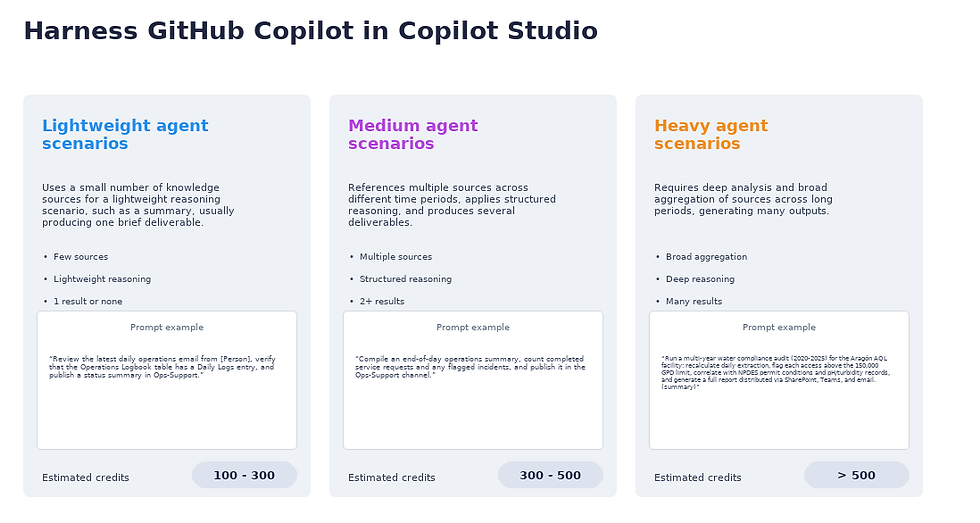
We've reached the end of the movie. END? Hopefully, but it's going to be not, licensing will continue to be a labyrinth worthy of The Shining, but at least now you have a compass and a flashlight.
And since I don't know when you'll be reading this, one last piece of advice: remember to check with the updated official information, it could have changed.
Comments